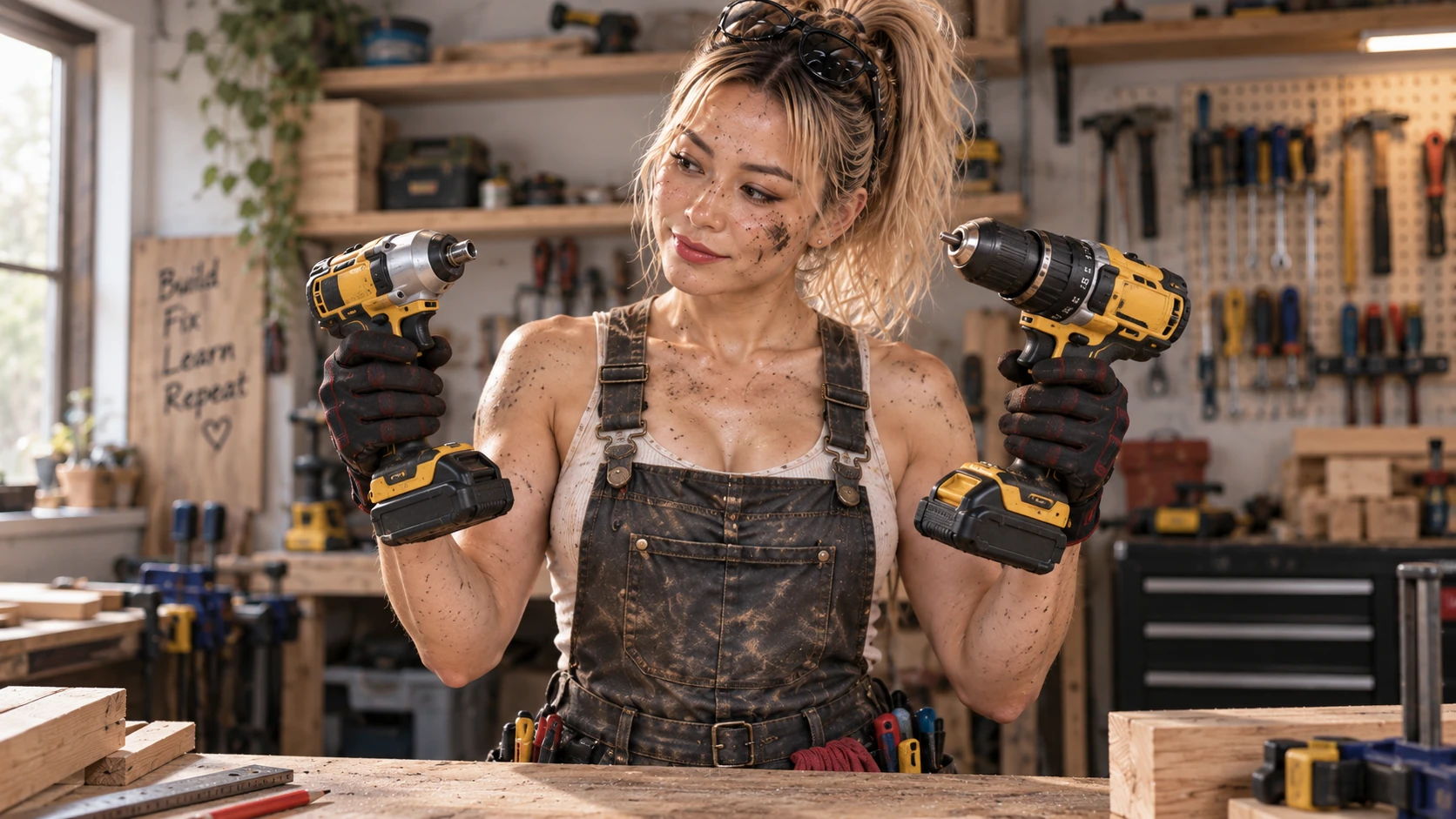
What is a cordless drill/driver?
A drill/driver combines a rotating chuck for drilling with a clutch and trigger that make it useful for driving screws. Most models have a three-jaw keyless chuck, variable-speed trigger, forward/reverse selector and removable battery. Many also offer an adjustable clutch, a drill mode and a gearbox selector.
The three jaws move inward to grip compatible round-shank and hex-shank accessories within the chuck’s capacity. That broad compatibility is a big reason a drill/driver is a foundational DIY tool. Learn the controls and basic technique in How to Use a Cordless Drill: A Beginner’s Guide.
What is an impact driver?
An impact driver is designed primarily for fastening. It usually has a compact body, a 1/4-inch hex quick-release collet, a variable trigger, forward/reverse and a removable battery. The collet is made for compatible 1/4-inch hex-shank bits and accessories rather than an ordinary three-jaw chuck.
At low resistance, it can rotate much like an ordinary powered driver. As the fastener meets more resistance, an internal mechanism delivers repeated rotational impacts to help keep it turning. It is not simply hammering the screw forward.
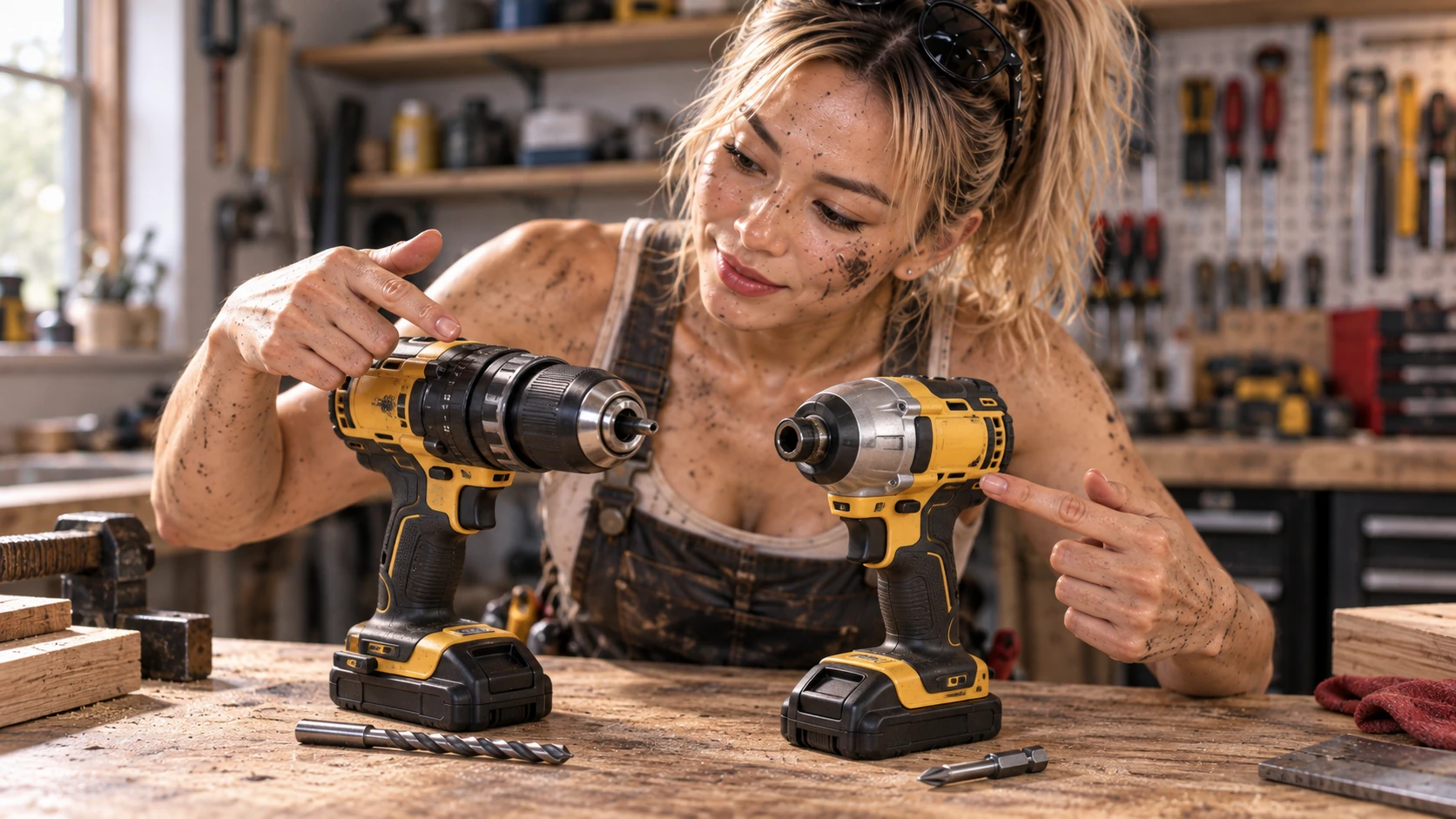
Three-jaw chuck vs 1/4-inch hex collet
The tool holder is an immediate clue to each tool’s intended strengths. The chuck grips a wide variety of compatible bits; the impact driver’s collet makes hex accessories quick to change and keeps its front end compact.
Drill/driver — three-jaw chuck
- Grips many round-shank drill bits and hex-shank bits within capacity
- Offers broad bit and accessory compatibility
- Opening and tightening the chuck takes more time than a quick-change collet
Impact driver — 1/4-inch hex collet
- Accepts compatible 1/4-inch hex-shank accessories
- Allows fast bit changes and a compact front end
- Does not directly accept ordinary round-shank drill bits without a suitable adapter
For demanding impact-driver work, choose bits and accessories rated or otherwise suitable for impact loading. A regular accessory is not automatically designed for repeated impacts.
How does the impact mechanism work?
Think about what happens as a screw gets harder to turn. At first, the motor rotates the bit smoothly. When resistance rises, the impact mechanism engages and adds repeated rotational impulses. Those short bursts help turn the fastener without relying only on a steadily increasing motor load.
This is why a compact impact driver can handle demanding fastening jobs. Its impacts are rotational, unlike a hammer drill, which adds axial percussive action along the drilling direction for suitable masonry applications. They are different mechanisms.
Why does an impact driver sound different?
Under light load, an impact driver may sound fairly ordinary. As resistance rises and the impact mechanism starts cycling, the quick succession of impacts creates its characteristic rattling or hammering sound. Use hearing protection when the noise level and duration of your work warrant it.
Where a drill/driver makes more sense
- Drilling pilot holes and general holes in wood
- Many metal or plastic drilling tasks with a suitable bit, speed and technique
- Controlled screw driving and delicate fastening
- Work that benefits from the adjustable clutch
- Jobs that need ordinary round-shank drill bits
No single bit suits every material. Match the bit and operating approach to the material and the manufacturer’s guidance.
Where an impact driver makes more sense
- Repeated screw driving and fastening
- Longer screws or more demanding fastening, when the fastener and material suit the tool
- Tighter access where a compact nose and body help
- Jobs using compatible hex-shank fastening accessories
That does not mean every large fastener should go in with an impact driver. Fastener type, material and manufacturer instructions still matter.
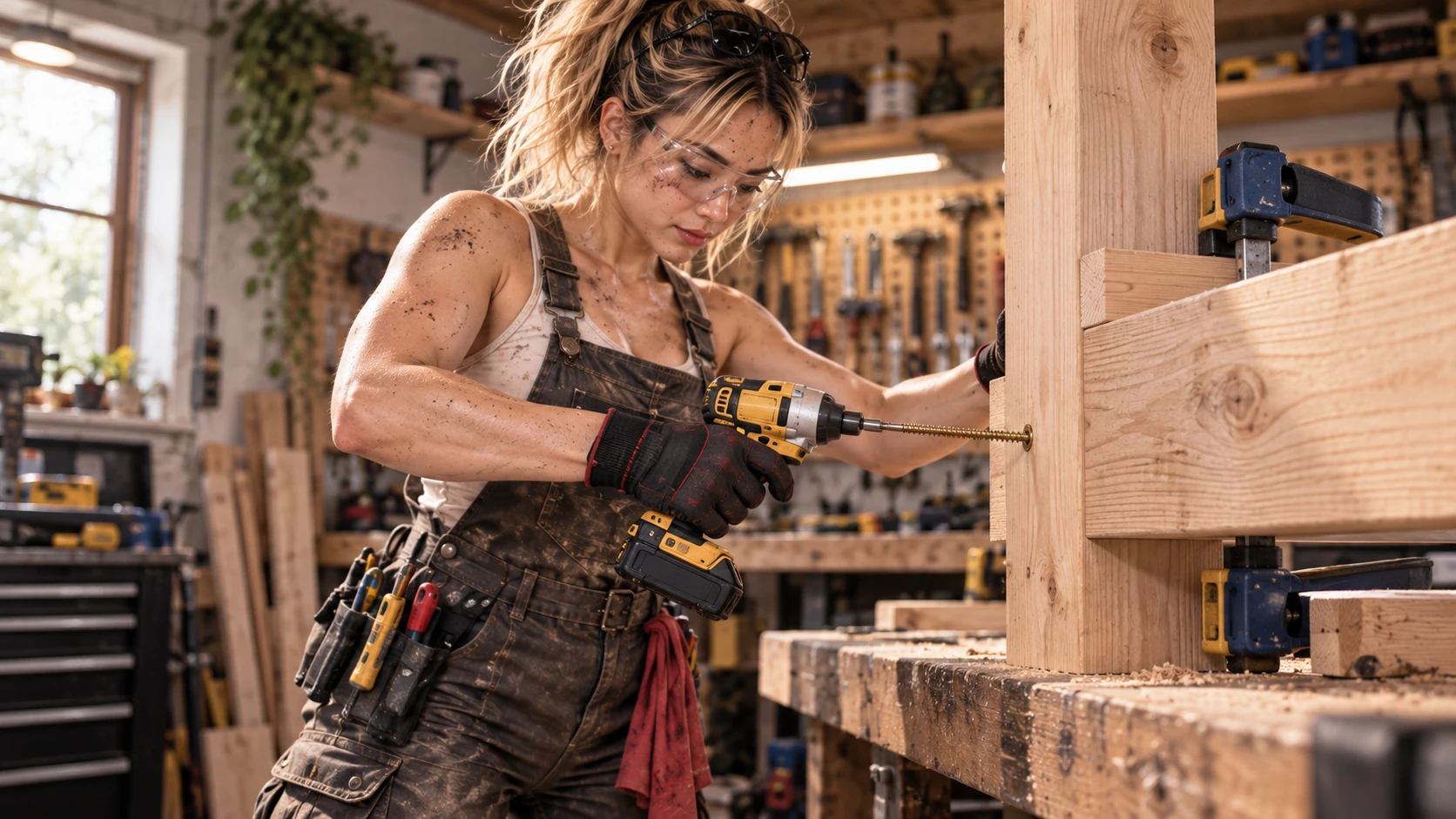
Here you can see a hex driver bit, a structural screw and a clamped timber assembly. This is a fastening operation: the impact driver turns the screw, and there is no conventional drill chuck. Compare it with the pilot-hole operation in our cordless drill tutorial. A pilot hole and driving the fastener are separate jobs, and using both tools can make that workflow convenient. The pictured screw does not universally require an impact driver.
Can a drill drive screws?
Yes. A drill/driver is often excellent at screw driving. Its clutch can be especially useful when you want to control how firmly a screw seats, and for many beginner DIY jobs a drill/driver may be all you need. There is no need to buy another tool just to make ordinary screw driving possible.
Can an impact driver drill holes?
Yes, with compatible 1/4-inch hex-shank drilling accessories. A conventional drill/driver is generally more versatile for drilling because of its adjustable chuck and broader bit compatibility. An impact driver can drill in some situations; it does not replace a drill universally.
Which tool gives more control?
It depends on the task. For delicate screw driving, a drill/driver’s adjustable clutch is useful. For demanding fastening, an impact driver’s mechanism and compact design can make the job easier. Neither is the overall winner for every kind of control.
What about torque?
Impact drivers are often advertised with large peak-torque numbers, but comparing numbers across different tool mechanisms is not always apples to apples. And neither those numbers nor an impact driver’s clutch-free fastening action provide a calibrated final torque. If a fastener has a specified final torque, follow the proper procedure and use a suitable torque wrench; see How to Use a Torque Wrench: A Beginner’s Guide.
Drill vs impact driver comparison
| Feature | Drill/driver | Impact driver |
|---|---|---|
| Tool holder | Three-jaw chuck | 1/4-inch hex collet |
| Primary strength | Drilling and versatile controlled fastening | Fastening |
| Bit compatibility | Broad, within chuck capacity | Compatible hex-shank accessories |
| Clutch | Commonly has an adjustable clutch | Generally lacks a conventional numbered drill clutch |
| Size | Typically has a longer front section | Typically has a more compact nose |
| Drilling | Core capability | Possible with compatible accessories; less universally versatile |
| Demanding fastening | Capable, depending on the job and tool | A major strength |
Which should a beginner buy first?
Choose based on the work you actually expect to do:
A drill/driver may be the better first tool if you mostly:
- Drill holes and do general home DIY
- Alternate between drilling and screw driving
- Want broad bit compatibility from one versatile tool
Consider an impact driver if you often:
- Drive lots of screws or longer fasteners
- Do repetitive fastening or work in compact spaces
- Already own a drill/driver and want a complementary tool
Some people appreciate owning both: use the drill for a pilot hole, then the impact driver to drive the fastener. It can save repeated bit changes, but it is a convenience, not a requirement.
Do you need both?
Not necessarily. A beginner doing occasional household DIY may be perfectly well served by one drill/driver. Someone doing frequent woodworking, construction-style projects or repetitive fastening may find both tools useful because they complement each other.
Common beginner mistakes
- Assuming an impact driver is simply a stronger drill
- Trying to put a round-shank bit directly into an impact collet
- Using accessories that are not suitable for demanding impact loading
- Using excessive power on delicate screws or stripping screw heads
- Choosing a poor bit-to-fastener fit
- Confusing an impact driver with a hammer drill
- Treating advertised torque numbers as the whole story
- Using an impact driver for precision final torque
- Buying both tools before you know whether your work calls for both
Cordless Drill vs Impact Driver FAQ
What is the main difference between a drill and an impact driver?
A drill/driver is a versatile drilling and controlled-fastening tool with a three-jaw chuck. An impact driver is fastening-focused, with a 1/4-inch hex collet and a mechanism that adds rotational impacts as resistance rises.
Can a drill drive screws?
Yes. A drill/driver is often very good at it, and its adjustable clutch can help control how firmly the screw seats.
Can an impact driver drill holes?
Yes, with compatible hex-shank drilling accessories. A drill/driver is generally more versatile because its chuck accepts a wider range of bits.
Why is an impact driver louder?
When resistance rises, its impact mechanism delivers a rapid series of rotational impulses. That repeated action creates the characteristic sound.
Can I put normal drill bits in an impact driver?
Ordinary round-shank bits do not fit directly into a 1/4-inch hex collet. Use compatible hex-shank bits or an appropriate adapter, and choose accessories suitable for impact loading.
Is an impact driver the same as a hammer drill?
No. An impact driver applies rotational impacts for fastening. A hammer drill adds axial percussive action along the drilling direction for suitable masonry applications.
Do I need both a drill and an impact driver?
No. A drill/driver is enough for many occasional DIY jobs. Both can be convenient for frequent drilling and fastening because their strengths complement one another.
Can I tighten wheel lug nuts with an impact driver?
Powered tools may be used in some workflows, but follow the vehicle and fastener manufacturer’s procedure for final tightening. An impact driver does not replace a torque wrench when a specified final torque is required.
Final thoughts
A drill/driver and an impact driver can both turn a fastener, but they approach the work differently. Start with the tool that suits your usual jobs. Learn its limits, choose accessories carefully and add a second tool only when it solves a real problem in your workshop.