
Too little tightening can allow movement or insufficient clamping. Too much can damage threads, overstress a fastener or distort a component. A torque wrench is a precision tool for controlled final tightening — not a magic wand and definitely not a substitute for the vehicle’s actual service specification.
What Is Torque?
Torque is a turning moment. The simple relationship is:
T is torque, F is force, and r is the perpendicular lever arm. The same force applied farther from the pivot creates more torque.
Torque is not exactly the same as clamping force. In a bolted joint, the desired result is often suitable fastener preload or clamping. Torque is an indirect way to help control it, and friction, thread condition and lubrication affect the relationship. Do not casually lubricate threads if the service specification assumes dry threads.
What Is a Click-Type Torque Wrench?
You set a target torque. When the preset threshold is reached, the wrench produces a tactile or audible click. The critical beginner rule is simple:
Do not continue pulling harder, and do not repeatedly click the same fastener just to “make sure.” Click → click → click does not make a bolt three times correct.
Before Using It
- Find the correct torque specification for the exact vehicle and component.
- Confirm the unit: N·m, lb-ft or lb-in. Never confuse lb-ft with lb-in.
- Select a wrench whose range includes the required value.
- Select the correct socket.
- Inspect the fastener and threads.
- Confirm whether the specification assumes dry or lubricated threads.

How to Set a Click-Type Torque Wrench
Designs vary, so use the instructions for your specific wrench. The general process is to unlock the adjustment mechanism, rotate the handle toward the required main-scale value, use the secondary or micrometer scale if applicable, confirm the final setting, and lock the handle.
Common mistakes include reading the wrong unit, misreading graduations, forgetting the secondary scale, forgetting to lock the handle, or setting outside the rated range. Never invent an example torque value for a job; use reliable manufacturer or service information.
How to Use It
- Start the fastener correctly. Never use the torque wrench to overcome cross-threading.
- Snug the fastener according to the actual assembly procedure.
- Install the correct socket.
- Set the required torque.
- Hold the wrench at its intended grip area.
- Keep the tool aligned and avoid unnecessary side loading.
- Apply smooth, controlled force. Do not jerk the handle.
- When the wrench clicks, stop.
The memorable sequence is: Set → Pull smoothly → Click → Stop.
Wheel Lug Nut Example
For a wheel, the wheel should be correctly seated and the lug nuts correctly started before preliminary snugging. Final tightening follows the vehicle specification and the required sequence. Many multi-lug wheels use an alternating or star-style sequence to distribute clamping load, but follow the actual vehicle procedure rather than treating that pattern as universal.
Torque Wrench vs Breaker Bar
A torque wrench is for controlled final tightening with a preset or measured value. A breaker bar provides high leverage and is useful for loosening stubborn fasteners, but it does not measure torque. Do not use a precision torque wrench as a breaker bar. Even if a wrench supports reverse measurement, that does not automatically make it suitable for breaking seized fasteners loose.
Torque Wrench vs Impact Wrench
An impact wrench is powered and useful for removal or initial work where appropriate. A torque wrench is controlled and precision-focused for final specified tightening. An impact wrench does not automatically guarantee correct final torque.
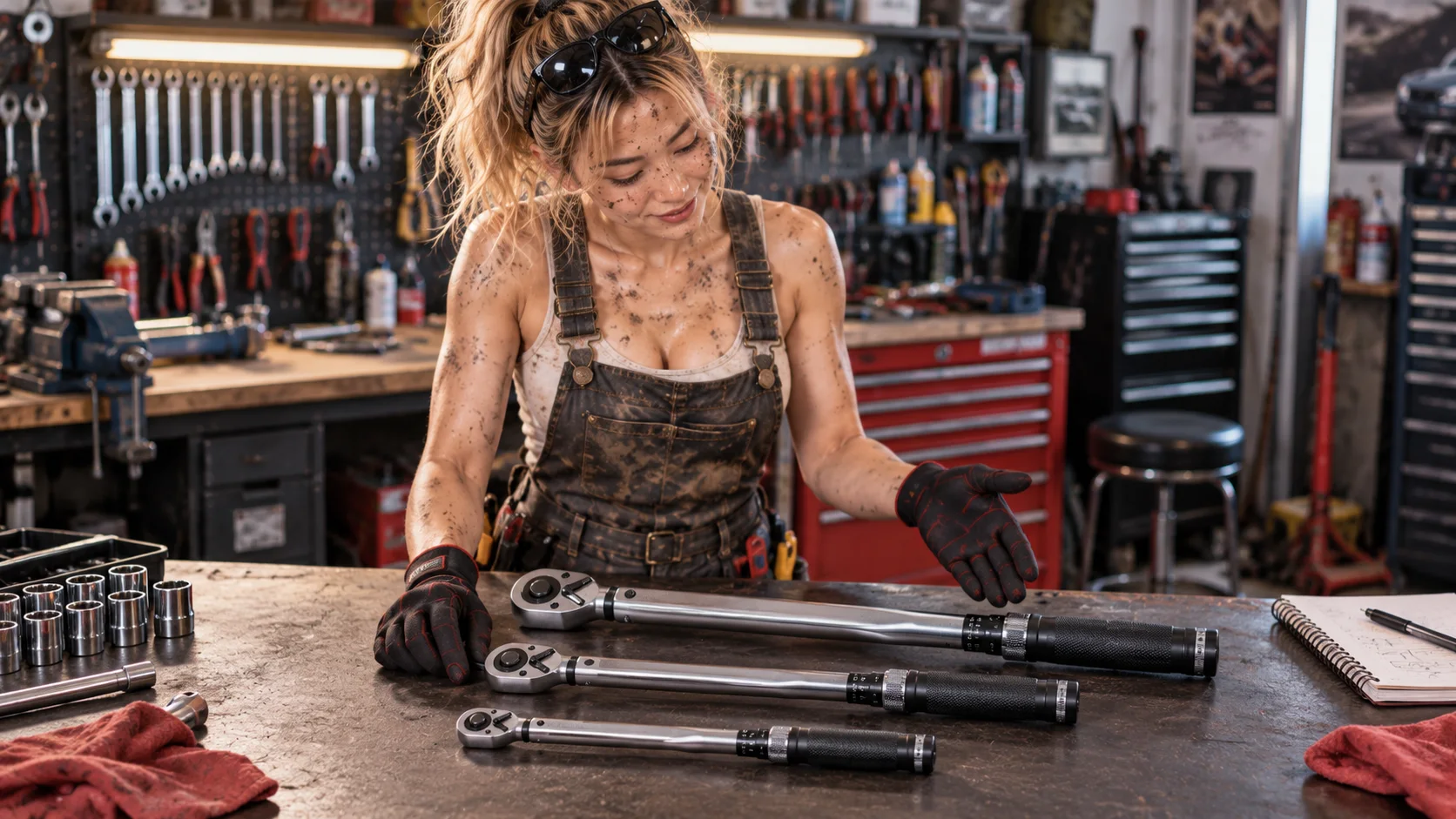
1/4 vs 3/8 vs 1/2-Inch Drive
A 1/4-inch drive is generally used with smaller fasteners and lower torque ranges. A 3/8-inch drive is a versatile middle size for many automotive tasks. A 1/2-inch drive is common for larger sockets and many higher-torque automotive jobs.
Drive size alone does not determine capability. Actual torque range matters, and no single drive size is universally best. For the related socket-size distinction, see our beginner guide to ratchets and sockets.
How to Choose a Torque Wrench
Choose based on the jobs you actually plan to do. Consider torque range, drive size, scale readability, available units, published accuracy information, measurement direction, locking mechanism, handle ergonomics, calibration information and whether a storage case is included.
One wrench may not sensibly cover everything from low-torque engine work to high-torque wheel fasteners. Range and accuracy matter more than simply choosing the biggest tool.
Storage
Many mechanical click-type wrench manufacturers recommend reducing spring preload for storage, but do not wind every wrench to absolute zero automatically. Some specify the minimum marked setting or another procedure. Follow the tool manufacturer’s instructions.
Keep the wrench clean and dry, use its case, avoid impacts, do not use it as a hammer, and do not throw it loosely into a toolbox.
Calibration
A torque wrench is a measuring tool. Accuracy may change through wear, heavy use, overload, dropping or impact, and improper storage. Calibration or checking intervals depend on the manufacturer, usage and required precision. There is no single universal interval to apply to every wrench.
Common Beginner Mistakes
- Guessing the torque specification
- Using the wrong unit or confusing lb-ft and lb-in
- Choosing the wrong wrench range
- Misreading the scale
- Using the wrench as a breaker bar
- Jerking the handle or pulling after the click
- Using the wrong socket
- Lubricating threads when the specification assumes dry threads
- Exceeding the rated range
- Dropping the wrench and assuming its accuracy is unchanged
- Storing it incorrectly
- Assuming bigger is always better
- Correct torque specification
- Correct unit
- Correct socket
- Correct wrench range
- Setting locked
- Fastener correctly started
Set → Pull smoothly → Click → Stop.
A torque wrench isn’t for making bolts “really tight.” It’s for tightening them to the engineering specification.
Torque Wrench FAQ
What is a torque wrench used for?
It helps control the final tightening of a fastener to a specified torque, supporting the intended clamping result.
How do I know what setting to use?
Use the exact vehicle, component or fastener manufacturer specification. Do not guess or reuse a value from another job.
What does the click mean?
It means the preset threshold has been reached. Stop pulling.
Should I click it more than once?
No. Repeated pulls after the click can add tightening and do not improve accuracy.
Can I use a torque wrench to loosen bolts?
It is not a breaker bar. Use the tool manufacturer’s guidance, but generally use a suitable ratchet or breaker bar for loosening.
Can an impact wrench replace a torque wrench?
No. An impact wrench can assist with removal or initial work, but final specified tightening still needs appropriate control.
Is 3/8 or 1/2-inch better?
Neither is universally better. Choose the drive size and torque range that match the work.
Should I store a torque wrench at zero?
Follow the manufacturer’s storage instructions. Some specify the minimum marked setting rather than absolute zero.
Does a torque wrench need calibration?
Accuracy should be checked or calibrated according to manufacturer guidance, usage and the precision required.
Final Thoughts
A torque wrench is not about making a fastener as tight as possible. It is about applying the right controlled tightening for the actual joint, then stopping when the tool tells you the target has been reached.