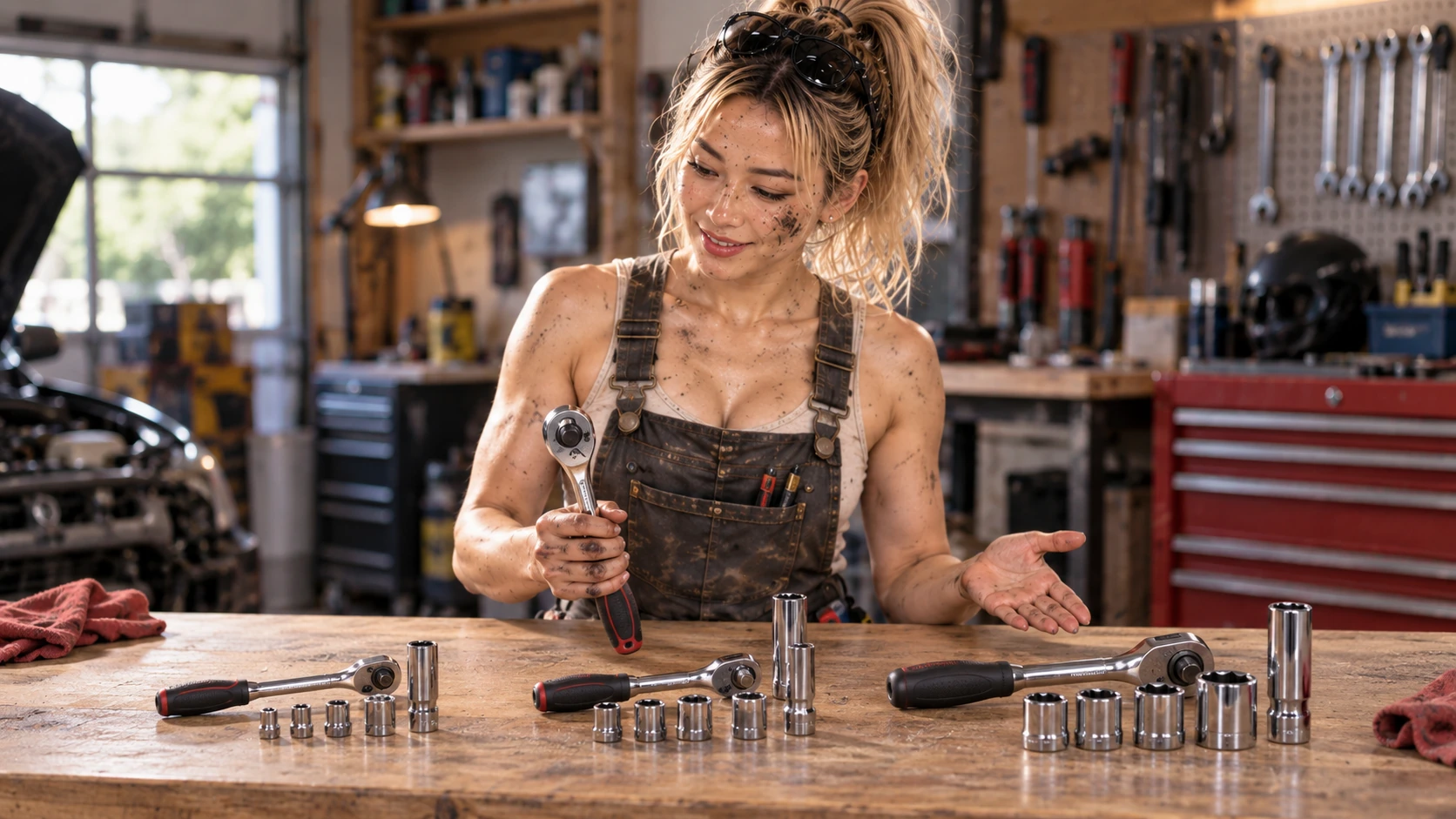
Anatomy of a socket and ratchet
The ratchet handle contains a mechanism that lets the socket turn the fastener on a working stroke and reset on the return stroke without removing it. Here is the basic connection:
- Ratchet: the handle and reversible ratcheting mechanism.
- Square drive: the male square tang on the ratchet head.
- Socket drive recess: the matching square opening in the back of the socket.
- Socket opening: the shaped end that fits over the nut or bolt head.
- Fastener: the nut or bolt you are turning.
The three common drive sizes
These fractions describe the square drive connection. Tool bodies and socket ranges vary by manufacturer and set, so consider them common patterns rather than strict limits.
1/4-inch drive
Compact and handy when access is tight. Often paired with smaller sockets for lighter fastening, small assemblies, interior work, and suitable small machinery or bicycle jobs.
Why choose itIts smaller head and handle can fit where a larger ratchet is awkward. It is not a license to apply unlimited force; use the tool and socket within their intended service.
3/8-inch drive
A versatile middle size used for many general mechanical and automotive tasks, including plenty of engine-bay maintenance and medium-size sockets.
A useful place to startIf you are building a first general-purpose automotive hand-tool kit, 3/8-inch drive is often a very useful place to start—but the correct tool still depends on the job.
1/2-inch drive
A larger, heavier tool system commonly used with larger sockets and jobs involving higher loads, such as some suspension or chassis work.
For specified tighteningFor wheel fasteners or any job with a final torque specification, follow the vehicle/service procedure and finish with an appropriate torque wrench.
Ratchets, sockets, extensions and adapters have different designs and ratings. Follow the maker’s limits and the service instructions for the fastener. Never use a normal ratchet to guess the final torque on a wheel fastener.
Quick comparison
1/4-inch
Typical toolSmall ratchet and compact sockets
Typical useLight fastening and restricted access
Why choose itSmall head and handle can reach tight spots
3/8-inch
Typical toolMid-size ratchet and broad socket selection
Typical useGeneral mechanical and automotive maintenance
Why choose itA useful balance of access and tool size for many jobs
1/2-inch
Typical toolLarger ratchet and larger sockets
Typical useSome chassis, suspension and higher-load work
Why choose itUse when the application and tool ratings call for the larger system
Drive size is not socket size
A 3/8-inch drive ratchet does not mean it only turns nuts that measure 3/8 inch. That fraction describes the square interface on the ratchet. A compatible 3/8-inch-drive socket can have a 10 mm, 12 mm, 13 mm, 14 mm or 17 mm fastener opening, depending on the set. It can also have an SAE opening such as 1/2 inch.
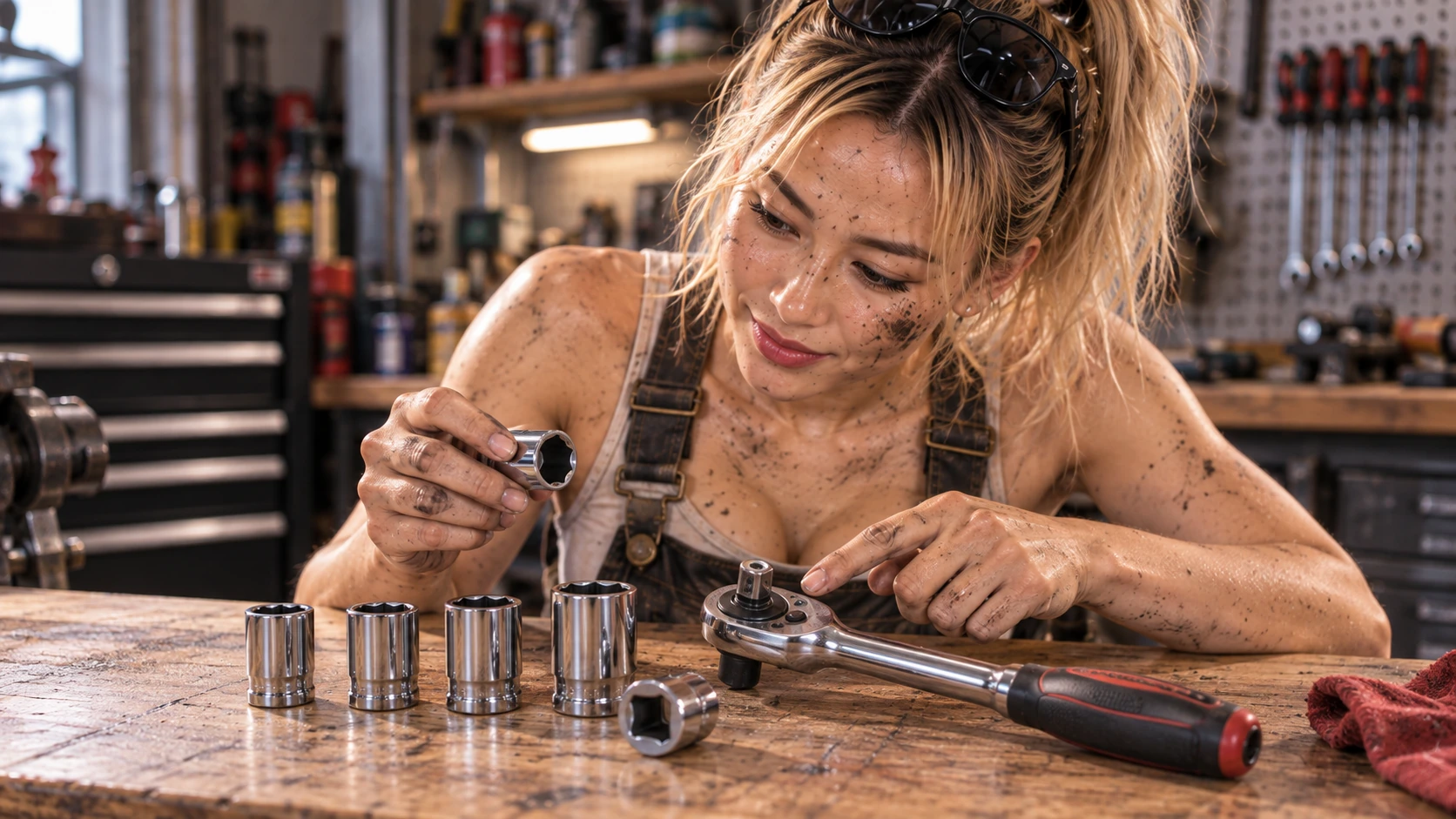
SOCKET SIZE = fastener fit
The socket has two different ends: its square recess fits the ratchet’s drive, while its other opening fits the fastener. If you hear someone say “a 1/2-inch socket,” ask which dimension they mean: a 1/2-inch drive, or a socket whose fastener opening measures 1/2 inch?
Metric vs SAE sockets
Metric socket openings are labeled in millimeters, such as 8 mm, 10 mm, 13 mm or 17 mm. SAE (inch-system) openings are labeled in fractional inches, such as 3/8, 7/16, 1/2 or 9/16 inch.
So both of these can exist: a 3/8-inch-drive socket with a 10 mm opening, and a 3/8-inch-drive socket with a 1/2-inch SAE opening. In the first, 3/8 inch is the square connection and 10 mm is the fastener size. In the second, one dimension happens to be 3/8 inch and the other is 1/2 inch.
Use the correctly fitting system and size. Do not force a metric socket onto an SAE fastener (or the reverse) because it seems close; a poor fit can round the fastener or slip.
6-point vs 12-point sockets
The number of points describes the shape inside the socket opening. A 6-point socket has six internal faces and is a common choice for ordinary hex fasteners, offering substantial contact when it fits correctly. A 12-point socket has more indexing positions, which can make it easier to engage when the handle has limited swing; it is also needed for certain 12-point fasteners.
Choose the point count that properly matches the fastener and access. Neither type is the universal answer for every fastener.
Shallow vs deep sockets
A standard (often called shallow) socket is shorter and more compact, useful when there is enough clearance above the fastener. A deep socket has a longer body and can reach nuts on protruding studs or fasteners recessed in a narrow opening when the geometry suits.
Deep sockets are not automatically better: their added length can make access harder in a tight space. The fastener, surrounding parts and available clearance decide which one fits the job.
What does an extension do?
An extension sits between the ratchet and socket to add reach:

An extension changes the distance between your hand and the fastener, not the socket’s opening. It does not turn a normal ratchet into a torque wrench or automatically increase the allowable torque. Long extensions, adapters and universal joints can change access and feel; choose components rated for the work and follow the tool maker’s guidance.
What about adapters?
Square-drive adapters connect compatible components with different drive sizes—for example, to fit a smaller-drive socket onto a larger-drive ratchet. An adapter only changes the connection. It does not make the smaller component as strong as the larger drive system. The ratings and limits of every part in the chain still matter, and adding adapters is not a safe substitute for the correctly sized tool.
Ratchet vs breaker bar vs torque wrench
Ratchet
A convenient hand tool for turning and resetting on the return stroke. It does not measure torque.
Breaker bar
A non-ratcheting handle that provides leverage for loosening fasteners when appropriate. Use it with components rated for the job.
Torque wrench
A measuring tool for final tightening when a specification is given. Set and use it as instructed; do not use it as a breaker bar.
For wheel fasteners, spark plugs and other critical joints, use the specified procedure and torque value. Our beginner torque-wrench guide covers controlled final tightening.
How do you choose a drive size?
- What fastener and socket opening does the job require?
- How much working room is available around it?
- What load is involved, and what do the tool and socket ratings allow?
- Does the service procedure give a final torque specification?
- Will the ratchet, socket, extension and any adapter all suit the application?
For small, tight, lighter work, a smaller drive tool is often convenient. For general automotive maintenance, 3/8-inch is commonly useful. For larger or higher-load work, a 1/2-inch system may be more appropriate. Those are starting points, not rigid rules: the fastener, access and manufacturer guidance decide.
Common beginner mistakes
- Confusing the ratchet’s square-drive size with the socket’s fastener opening
- Using a loose-fitting socket or forcing a near match
- Mixing metric and SAE because one “almost fits”
- Applying excessive leverage to a small ratchet
- Using a torque wrench as a breaker bar
- Assuming chrome hand sockets are suitable for impact tools without checking their rating
- Blindly stacking adapters or extensions
- Ignoring tool, socket and accessory ratings
- Tightening an important fastener without checking its specified torque
Hand sockets and impact sockets
Do not assume an ordinary chrome hand socket is suitable for powered impact use. Impact-rated sockets are designed for impact-tool service according to their manufacturer’s specifications; check the socket markings and instructions. An impact driver and an impact wrench are different tools: an impact driver commonly accepts 1/4-inch hex accessories, while an impact wrench uses a square drive for sockets. Read our drill vs impact driver guide for the impact-driver distinction; do not treat that as an impact-wrench guide.
Socket and Ratchet FAQ
What is the most useful ratchet size for beginners?
3/8-inch drive is commonly versatile for general mechanical and automotive work, but no one drive size covers every task. Choose for the fastener, access, load and manufacturer ratings.
Does a 3/8-inch ratchet only use 3/8-inch sockets?
No. The ratchet’s 3/8-inch drive is the square connection size. Sockets with a compatible 3/8-inch drive can have many different metric or SAE fastener openings.
Can I put a 1/2-inch socket on a 3/8-inch ratchet?
The phrase “1/2-inch socket” is ambiguous. If 1/2 inch is the fastener opening, that socket may be made with a 3/8-inch drive and fit directly. If it means a 1/2-inch-drive socket, it will not fit a 3/8-inch ratchet directly; a suitable adapter can connect them, but it does not change component ratings.
What is the difference between metric and SAE sockets?
Metric socket openings are measured in millimeters; SAE openings use fractional inches. Match the socket to the fastener system and use a close, proper fit.
Do I need both deep and shallow sockets?
They solve different access problems. Standard sockets are shorter; deep sockets reach over protruding studs or into some recessed areas. Buy or use the shape your actual work needs.
What does a ratchet extension do?
It adds reach between the ratchet and socket. It does not change the fastener opening, set torque or automatically increase the rated capacity.
Can I use a normal socket with an impact wrench?
Only use sockets and accessories the manufacturer specifies as suitable for impact-tool service. Ordinary hand sockets are not automatically impact-rated.
Is a ratchet the same as a torque wrench?
No. A ratchet turns fasteners; a torque wrench measures or controls tightening to a specified value. A normal ratchet does not measure torque.
Final thoughts
When the fractions get confusing, look at which end they describe. Drive size is the square connection between the ratchet and socket. Socket size is the opening that fits the fastener. Choose the opening for the fastener, the drive for the tool and access, and a torque wrench when the service procedure calls for specified final tightening.